Custom Exhaust Secrets Revealed: What Experts Don’t Want You to Know

Your vehicle speaks to you every time you turn the key. Sometimes it’s a confident purr, other times it’s a rhythmic thrum, and occasionally, it’s a raspy cough that tells you something is wrong under the chassis. When it comes to your exhaust system, many drivers think of it simply as a series of pipes designed to move smoke away from the engine. However, your exhaust is actually a precision-tuned instrument that dictates your car’s power, fuel efficiency, and “personality.”
In the world of automotive performance, there is a lot of misinformation. If you’ve been searching for a “custom exhaust” or an “exhaust shop near me” in Cedar Rapids, you’ve likely encountered a mix of marketing hype and genuine advice. At Denny’s Automotive & Muffler Center, we believe in transparency. There are secrets to exhaust performance that some shops might skip over to save time or sell you unnecessary parts.
Today, we’re pulling back the curtain on what really makes a high-performance system work and how you can get the best custom exhaust for your vehicle without falling for common industry myths.
The “Bigger is Better” Myth: Why Diameter Destroys Performance
One of the most persistent secrets that many shops won’t correct is the idea that a larger pipe diameter always equals more horsepower. It’s an easy sell: “Look at this massive 4-inch pipe; your truck will roar!”
The reality is far more technical. Your engine relies on a phenomenon called “exhaust velocity” and “scavenging.” Think of your exhaust like a straw. If the straw is too narrow, it’s hard to blow air through. But if the straw is the size of a sewer pipe, the air just sits there.
For an internal combustion engine to work efficiently, the exhaust gases need to move quickly. High velocity creates a vacuum effect (scavenging) that actually helps pull the next cycle of exhaust out of the cylinder. If you install a pipe that is too large for your engine’s displacement, that velocity drops. The gases cool down, become heavy, and create turbulence. The result? You lose low-end torque, and your car feels “sluggish” off the line.
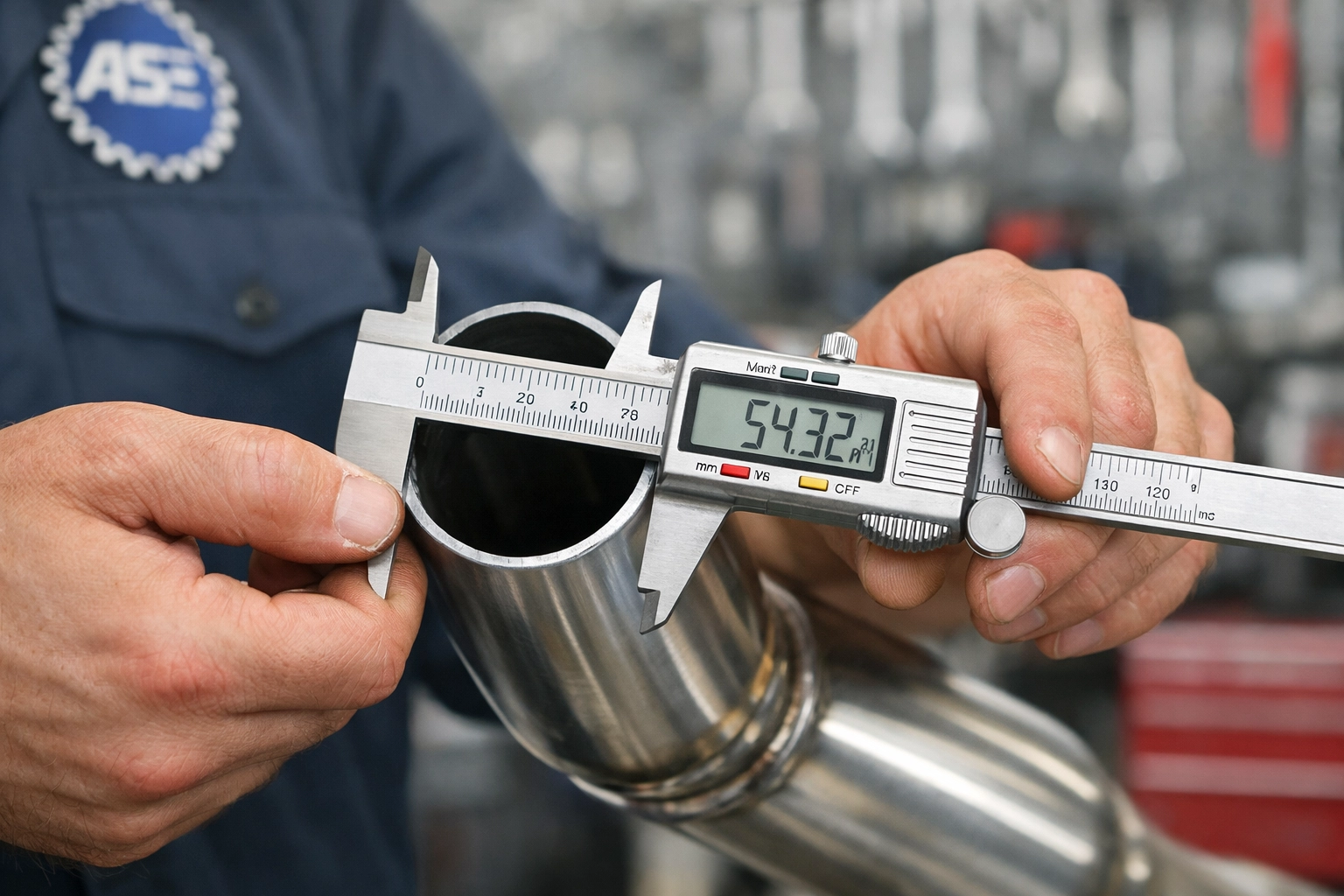
At Denny’s Automotive & Muffler Center, our ASE-certified technicians calculate the ideal diameter based on your engine’s output and your driving goals. We prioritize performance over “the look” of a giant pipe that actually slows you down.
The Secret of the Bend: Mandrel vs. Crush
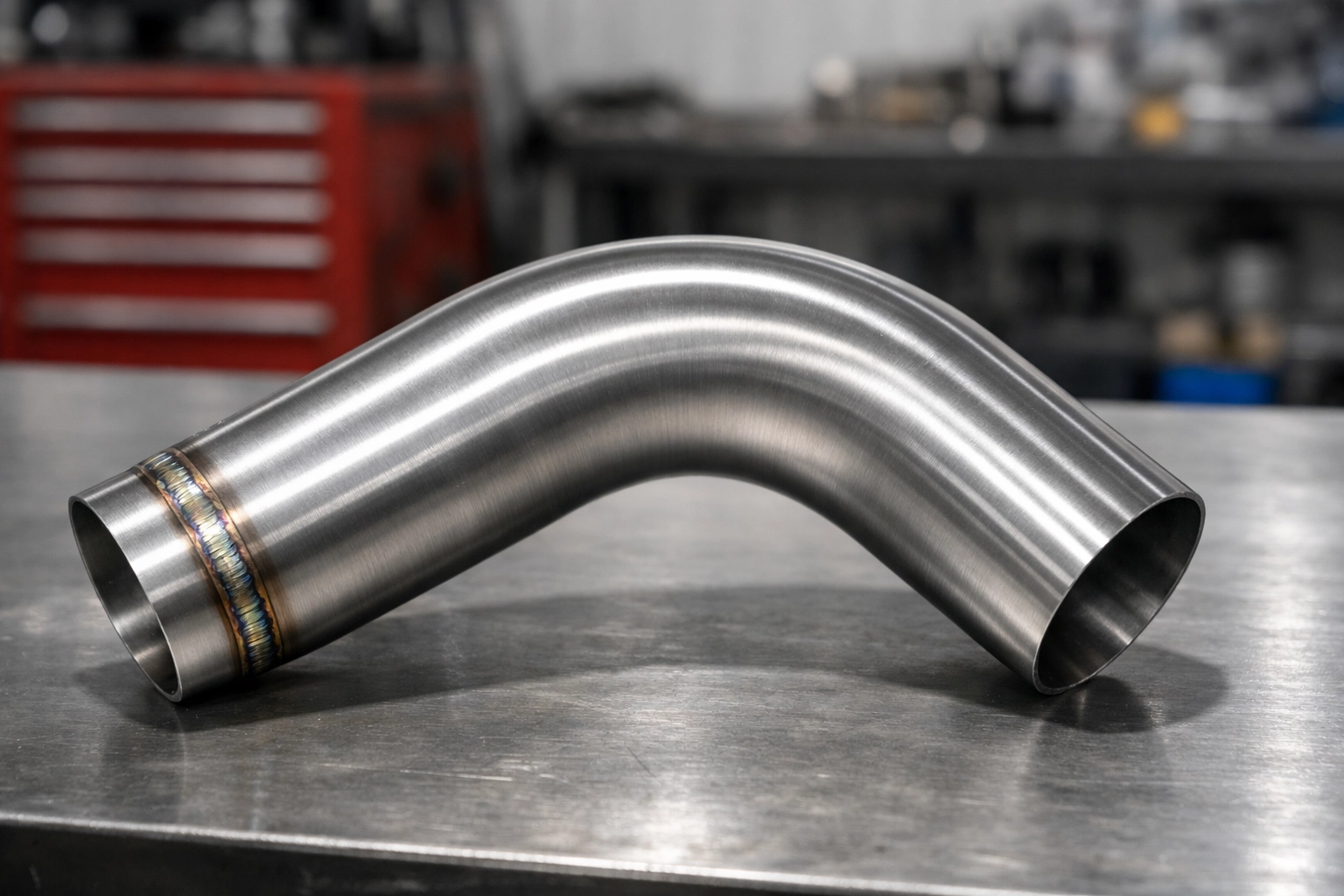
If you walk into a standard muffler shop, they might use a traditional hydraulic pipe bender. To the untrained eye, the result looks fine. However, this is what we call “crush bending.” As the machine forces the pipe into a curve, the inside of the bend collapses slightly, creating a restrictive kink.
Imagine a garden hose with a slight crimp in it; the water pressure drops. The same thing happens to your exhaust gases. A 2.5-inch pipe that is crush-bent might effectively become a 2-inch pipe at the corner.
The “expert secret” is mandrel bending. During this process, a solid steel rod (the mandrel) is inserted into the pipe during the bend. This supports the interior walls, ensuring the diameter remains consistent throughout the entire curve.
At Denny’s, we utilize advanced digital pipe bending capabilities. This allows us to create smooth, high-flow transitions that maximize your engine’s breathing capacity. It’s the difference between a system that looks custom and one that actually performs at a professional level.
Sound vs. Noise: The Science of Resonators and Mufflers
There is a big difference between a vehicle that sounds powerful and one that is just loud. A common mistake in the exhaust repair world is thinking that removing parts is the only way to get a “sporty” sound.
The secret to a great-sounding car isn’t just the muffler; it’s the relationship between the muffler and the resonator.
- The Muffler: Designed primarily to reduce overall sound volume by bouncing sound waves around internal chambers or through packing material.
- The Resonator: This is a specialized chamber designed to eliminate specific “drone” frequencies.
Have you ever been on a long highway drive in a car that has a constant, mind-numbing “hum” at 65 mph? That’s an un-tuned exhaust. An expert shop uses resonators to cancel out those annoying frequencies while letting the deep, aggressive tones pass through. We focus on “sound tuning”: treating your vehicle like an instrument so you get the growl you want when you hit the gas, without the headache on your daily commute in Cedar Rapids.
Material Durability: Why Stainless Steel is a Cedar Rapids Essential
If you live in Iowa, you know that our winters are brutal on vehicles. Between the snow, the ice, and the salt spread on the roads, the underside of your car is under constant chemical attack.
Many “budget” exhaust shops use aluminized steel. It’s cheaper and looks shiny when it’s new, but it’s prone to “rot” from the inside out as moisture from exhaust condensation sits in the pipes. In our climate, an aluminized system might only last a few years before you’re looking for “exhaust repair near me” all over again.
The secret to longevity is T304 or T409 stainless steel. While the upfront cost is higher, stainless steel is significantly more resistant to corrosion. Expert fabricators know that “stuff still rots out,” especially at the connections. By using high-quality materials and expert welding techniques, we build systems that can outlast the vehicle itself.
The Hidden Benefit: Weight Reduction
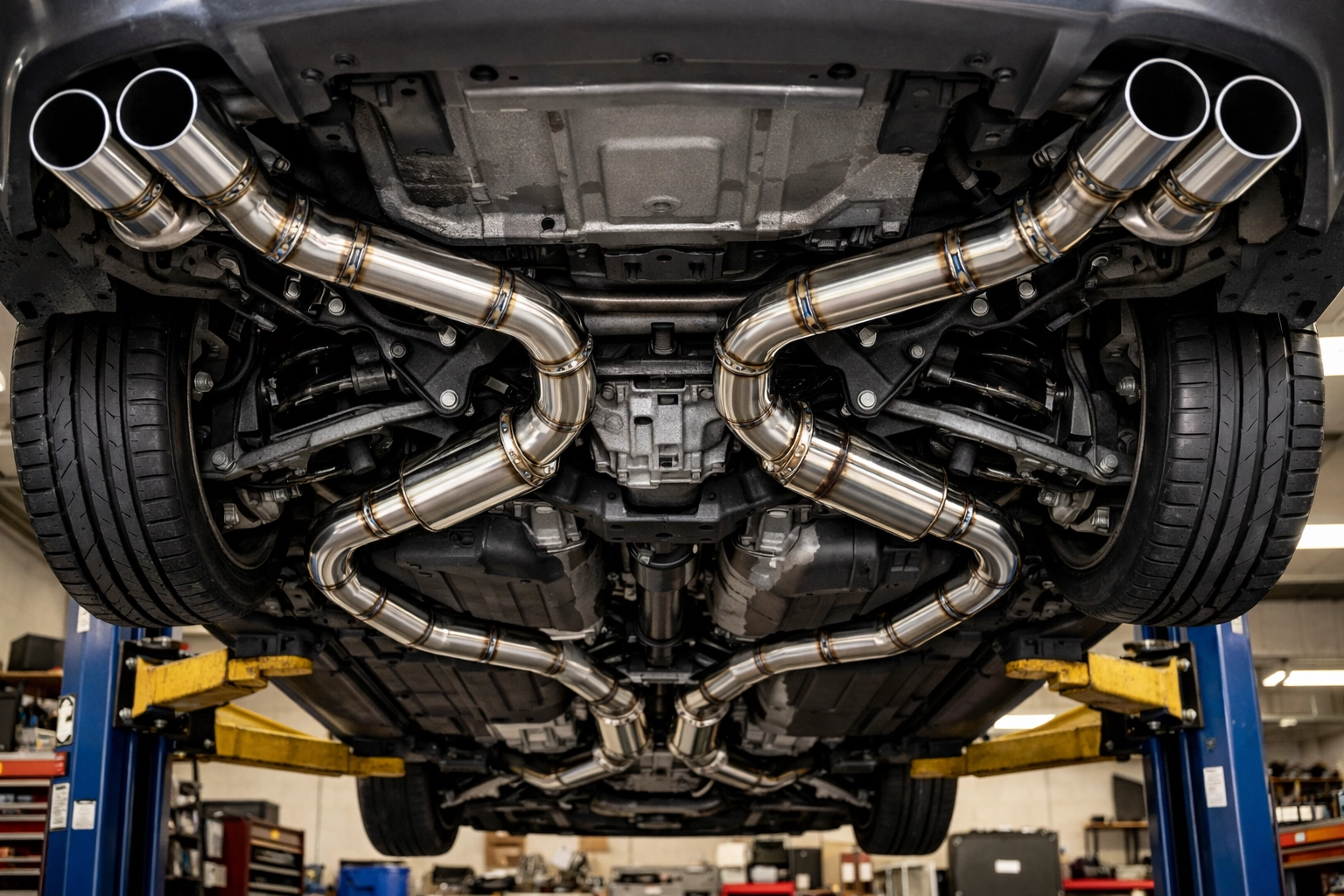
Standard factory exhaust systems are often heavy, bulky, and made of thick-walled cast iron or low-grade steel. A hidden secret of custom exhaust work is the performance gain found in weight reduction.
By switching to high-quality, thinner-walled (but stronger) stainless steel and a streamlined layout, we can often shave 20 to 50 pounds off a vehicle. While that might not sound like much, reducing “sprung weight” improves your power-to-weight ratio, which helps with both acceleration and fuel economy. It’s a subtle upgrade that makes your vehicle feel more nimble and responsive.
Why “Off-the-Shelf” Often Falls Short
You can go online and order a “bolt-on” exhaust kit for almost any car. They promise easy installation and perfect fitment. However, nearly 40% of custom projects: especially vintage car restorations or unique builds: face major challenges with these kits.
Every car has slight variations, especially as it ages. Frames can settle, and aftermarket parts like larger oil pans or different suspension setups can get in the way of a pre-manufactured pipe.
This is where Denny’s Automotive & Muffler Center excels. We don’t just “bolt things on.” We fabricate. We ensure that the clearance around your fuel lines, brake lines, and floorboards is safe and precise. A custom-fabricated system is built for your car, not just for your car’s model.
The Importance of Backpressure
You may have heard the term “backpressure” thrown around. Some people will tell you that engines need backpressure to work. This is a bit of a misunderstanding that some shops use to justify inefficient designs.
Engines don’t need “restriction” (backpressure); they need “scavenging” (velocity). If there is too much backpressure, the engine has to work harder to push the exhaust out, which steals power. If there is zero backpressure (like an open header), you lose the vacuum effect needed to pull the gases out efficiently at low RPMs.
Finding that “Goldilocks” zone: where the exhaust flows freely but maintains enough velocity to help the engine breathe: is the hallmark of an ASE-certified expert.
What to Do Next: Your Immediate Actions
If your car sounds different than it used to, or if you are dreaming of a performance upgrade, don’t just guess. Here is how you should proceed:
- Listen closely: If you hear a ticking sound when the engine is cold, you might have a manifold leak. If you hear a deep roar under your seat, it’s likely a hole in the muffler or mid-pipe.
- Check for “The Drone”: If you’ve recently had work done and the car vibrates uncomfortably at certain speeds, your resonator needs attention.
- Inspect for Rust: If you see “flaking” on your pipes, the structural integrity is compromised.
- Consult a Professional: Instead of buying a generic kit online, talk to a local expert who understands the Cedar Rapids driving environment.
The Denny’s Difference in Cedar Rapids
At Denny’s Automotive & Muffler Center, we’ve built our reputation on honest pricing and superior craftsmanship. We aren’t interested in selling you the biggest pipe or the loudest muffler if it doesn’t actually improve your vehicle.
Our team of ASE-certified technicians combines old-school fabrication skills with modern auto repair services to ensure your car runs better, sounds better, and lasts longer. Whether you need a simple exhaust repair or a full custom build, we treat every vehicle like it’s our own.
Don’t settle for “good enough” when it comes to your vehicle’s performance. Unlock the true potential of your engine with a system designed by experts who care about the details.
Ready to transform your ride? Contact Denny’s Muffler today to schedule a consultation or stop by our shop in Cedar Rapids for a 30-point inspection of your current system.
Related Posts

Can Summer Heat Really Destroy Your Tires? Here’s What Every Cedar Rapids Driver Needs to Know
When July and August temperatures soar across Eastern Iowa, we all feel the intensity. Between…

Looking For a Mechanic Near Me? 10 Things to Know Before Your Summer Road Trip
There is nothing quite like an Iowa summer. Whether you are heading up to the…

Getting Hitch-Ready: What to Know About Professional Trailer Hitch Installation in Eastern Iowa
There is something uniquely American about the freedom of the open road, especially here in…